
Enterprise websites with thousands or millions of pages face a different challenge than smaller sites. At this scale, technical errors in one template can replicate across entire product categories, blocking search engines from indexing revenue-driving pages.
Standard reporting tools often miss these patterns because they focus on individual page issues rather than template-level problems. By the time you notice ranking drops, competitors with cleaner architectures have already captured your organic traffic.
An enterprise SEO audit is designed to identify and fix these large-scale issues. So, let’s begin by looking at what these audits mean and how they work.
What Is an Enterprise SEO Audit?
An enterprise SEO audit evaluates large-scale websites to identify technical, content, and structural issues that limit organic growth. Basic audits may spot-check pages manually, but enterprise audits analyze URL patterns across entire site sections using automation.
This approach makes it possible to see whether issues are isolated or repeated as template-level patterns across thousands of pages. For example, one broken canonical tag might affect a single page on a small site. But on complex websites, that same error in a product template could create duplicate content issues across 50,000 web pages before search engines can index them properly.
Enterprise SEO audits use technical tools and automated crawling to find these patterns, then show which templates need fixing and the potential business impact.
Why Enterprise Websites Need Specialized Audits

Enterprise websites require specialized audits because standard approaches can’t track changes across thousands of templates or multiple international domains. A single CMS update can overwrite hreflang settings (tags that tell search engines which language version to show where) across 40 country sites, or generate duplicate title tags on 80,000 pages before anyone catches it.
That scale creates compounding complexity. Legacy code, multiple CMS platforms, and regional variations layer on top of each other over time. At the same time, different teams managing separate sections rarely follow consistent SEO guidelines. With organic search driving over 50% of website traffic, those inconsistencies translate directly into lost revenue when they spread across your entire site.
Specialized enterprise audits prioritize fixes by connecting technical findings to crawl behavior, ranking potential, and actual business outcomes rather than just listing problems.
Quick note: Not all website SEO audit services handle enterprise complexity well. So, look for providers who use automated crawling at scale and can coordinate fixes across multiple teams rather than delivering static reports.
Core Components of an Enterprise SEO Audit
Enterprise audits examine three main areas: technical infrastructure, content performance across page types, and international site structure. Each component reveals different bottlenecks, from crawl waste to weak content to broken hreflang implementation across markets.
Technical Infrastructure and Crawl Efficiency
Your technical foundation determines whether search engines can actually crawl and index your entire site. In practise, Google assigns each site a crawl budget based on server capacity and site authority. Waste that budget on duplicate content, broken links, or pagination loops, and your important pages get crawled less often.
Enterprise audits pinpoint where these bottlenecks happen, such as:
- Weak internal linking and orphaned pages
- Broken canonical tags or missing structured data
- Slow Core Web Vitals on mobile devices
From there, they show how to restructure internal links to guide search engine crawlers toward high-value content and fix technical SEO issues before they spread.
Content Quality Assessment Across Page Types
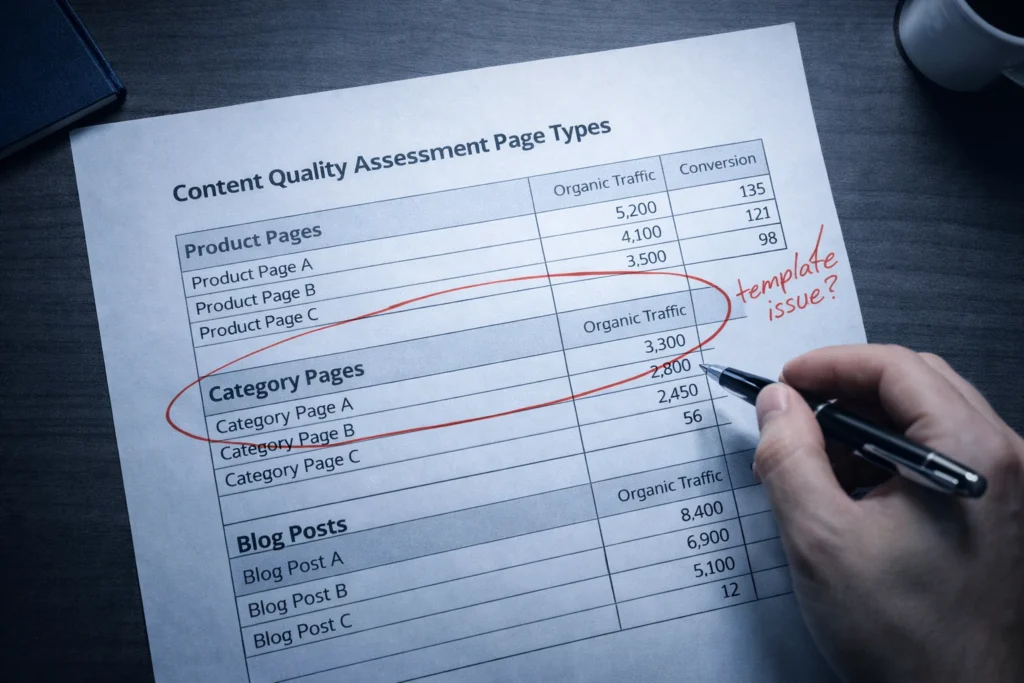
Regular seo audits review content quality page by page, but enterprise audits segment performance by page type to identify patterns at scale. This involves using two tools: Google Analytics and Google Search Console. The former shows which page types drive organic traffic and engagement, while the latter reveals which ones rank for relevant keywords but fail to convert visitors.
When you group pages by type, patterns become visible. For example, if all your product category pages underperform in search results, that signals a template issue rather than individual content problems.
Content gap analysis takes template insights further, identifying where competitors rank for high-value search queries your site misses entirely. The goal is scaling improvements across templates through content strategy changes, instead of optimizing pages one at a time.
International SEO and Site Architecture
Enterprise sites serving multiple markets face a specific challenge: how do you tell search engines which language version to show to which country? Hreflang tags solve that problem. If implemented correctly, they prevent duplicate content issues across language versions and direct each searcher to the right page for their region.
Site architecture handles a different but equally important function. It determines how link equity flows through your site, using hub-and-spoke models that connect regional pages and product categories logically. Without clear architecture, orphaned pages pile up across your site with no internal links pointing to them.
And when that happens, search engines can’t identify which pages should rank highest, and crawlers end up missing important content entirely.
How Enterprise Audits Handle Scale and Complexity
SEO audits once relied on spot-checking representative pages and assuming templates stayed consistent. Today, automated crawling systems analyze entire site sections to detect issues at enterprise scale through:
- Automated Crawling Tools: Platforms like Screaming Frog SEO Spider check thousands of pages simultaneously for broken links, duplicate content, missing meta descriptions, and technical SEO issues repeating across templates. No human reviewer can audit that volume consistently enough to catch what automated crawling finds.
- Intelligent Sampling by Template: Crawl data gets segmented by page type, region, and URL structure to reveal where problems concentrate. A site might have clean homepage code but broken canonical tags across 60,000 regional landing pages, which points to a template problem in one section.
- Business Impact Analysis: Rather than listing technical problems in isolation, enterprise audits connect findings to Google Analytics and Search Console data. That connection shows how crawl budget waste or poor user experience affects organic performance, which lets you prioritize fixes by revenue impact rather than technical severity alone.
The result is an actionable roadmap showing which templates to fix first and how much traffic you’ll recover by fixing them.
Prioritization: What to Fix First
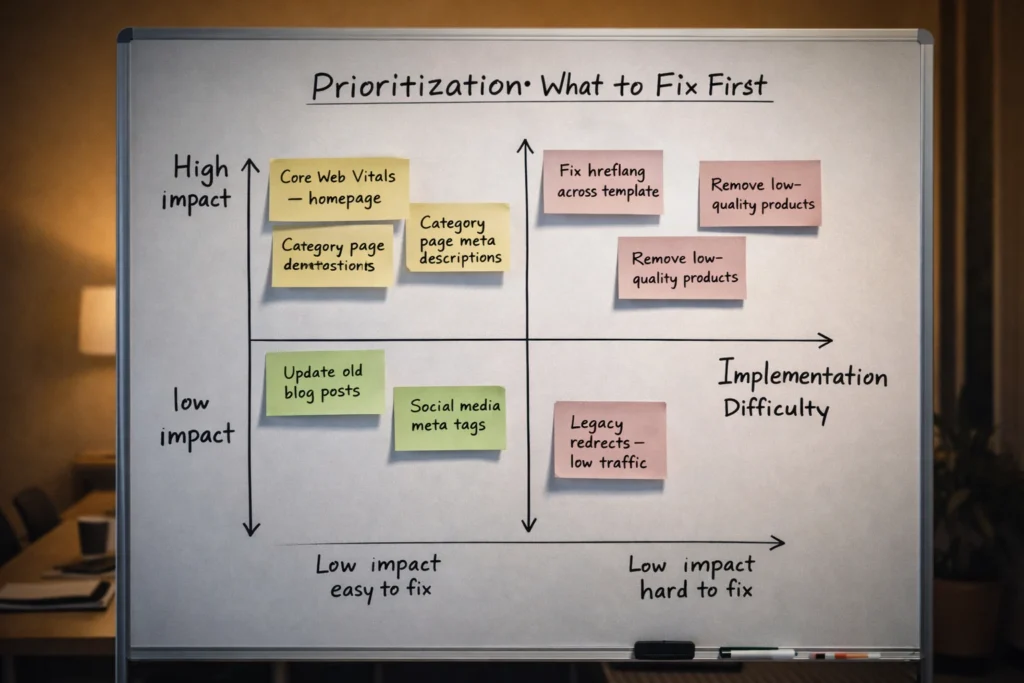
Picture this: your enterprise SEO audit surfaces 847 technical issues, 312 content gaps, and 129 structural problems spread across six regional sites. Without a clear prioritization framework, your teams may spend months fixing broken links on low-traffic pages while Core Web Vitals failures tank conversions on your most important pages.
That’s why effective prioritization ranks fixes by business impact first and technical severity second. A missing meta description on a product page driving 10,000 monthly visits takes priority over orphaned blog posts from 2018. Similarly, restoring link equity to revenue-generating category pages outweighs cleaning up legacy redirects that have no impact on current search engine rankings.
To scale this approach across hundreds of fixes, enterprise audits use scoring frameworks that rank each issue by potential traffic gain, implementation difficulty, and alignment with business objectives. These frameworks prevent teams from over-investing in low-impact optimizations, such as improving site speed on low-traffic pages, while high-value content remains buried in search results.
Get Expert Website SEO Audit Services for Your Enterprise Site
Enterprise SEO audits identify the technical bottlenecks, content gaps, and structural issues limiting organic growth at scale. Acting on those findings requires aligning fixes with your broader SEO strategy.
Start with quick wins like broken links and missing meta descriptions, then scope architecture overhauls as longer-term projects that keep revenue-generating pages protected throughout. Regular audits maintain that progress by catching new issues before they replicate across thousands of pages and undo months of work.
Click2Rank combines automated crawling with expert analysis to deliver website SEO audit services built for complex enterprise sites. Contact us today to identify what’s limiting your organic growth and where to start fixing it.